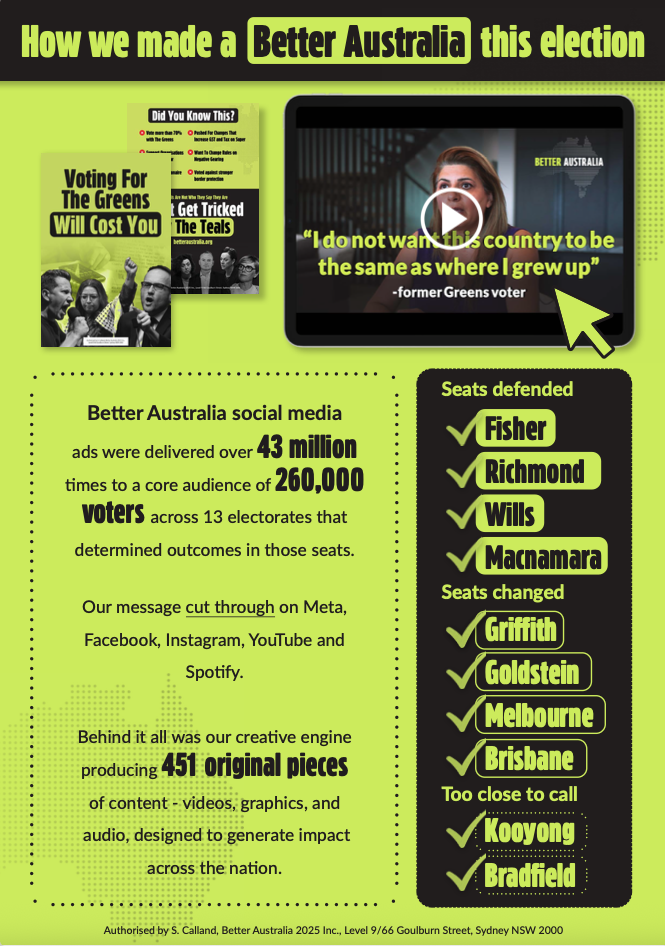
In the lead up to the 2025 federal election, which looked like it might result in a hung parliament, campaign group Better Australia formed to protect against the policy paralysis typical of governments dependent on minority parties for support.
As a non-partisan group, Better Australia’s purpose was not to sway the election for either major party but to secure “majority government for a better Australia”.
Objectives
The two key objectives briefed to Agenda C were to:
- Reduce the number of voters in Labor-Green contest seats voting Green,
- Reduce the number of voters in Liberal-Teal contest seats voting Teal
Audience identification
Agenda C foresaw that Australians would want to vote for stability during a time of increased global instability, a cost-of-living crisis and geopolitical uncertainty.
We also identified audiences which would be affected by specific Green and Teal policies so that we could target them with tailored messages specific to their concerns.
These audience groups included:
- Soft Green voters (45+)
- Swing voters who traditionally vote Liberal
- Parents with kids in non-govt schools (30+)
- Homeowners or about to buy home (35+)
- People with investment properties
- People with retirement savings (40+)
- People concerned about inheritance/inheriting
- People concerned with the cost of living
- People concerned with rising anti-semitism/fraying social cohesion
Key messaging
Working with Better Australia, Agenda C developed campaign messaging to connect with these audience groups.
Bridging our campaign objectives under one unified message, we formulated the message: Stronger choices. For a Better Australia.
This was supported by the descriptive: Don’t let the Greens and Teals take us in the wrong direction.
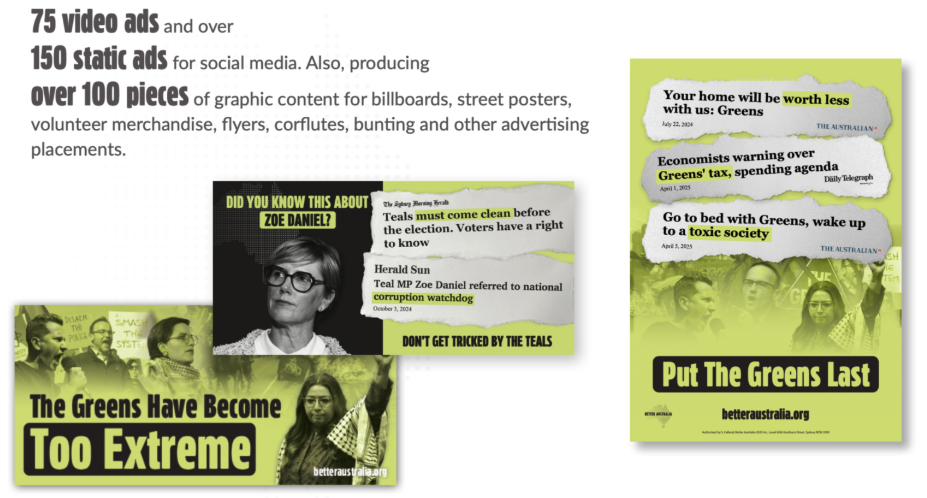
In electorates contested by a Teal, our slogan told voters Don’t Get Tricked By Teals, while in electorates contested by a Green, we encouraged voters to Put The Greens Last.
These messages ran across all our executions on the Better Australia website and across print and digital assets, encouraging voters to vote for the major parties and thereby suppressing votes for both the Greens and Teals.
Campaign branding
To stand out during the election and combat voter fatigue, especially with many parties having established visual brands, Better Australia needed a unique identity.
We recommended, high-vis green as a colour that was both visually striking and distinctive, as well as different enough from the colours used by others that it wouldn’t be confused with a political party or other third party campaign groups.
We used heavy weighted text and graphical elements to create a campaign brand that could be readily applied across out of home graphics, video, and digital.
Campaign creative
The campaign’s ads were developed in two separate tracks: one for areas where the main contest was between Labor and the Greens, and another for areas where it was between the Liberals and “Teal” independents.
Each ad was made more local by featuring local candidates or messages tailored to voters in those specific seats.
For example defence was a key issue in Richmond and defence related ads were deployed in that seat. In Labor-Green seats with higher proportions of older Australians, inheritance tax creative was implemented. Agenda C worked with Better Australia to brainstorm creative ideas, develop storyboards and rough layouts, and then produce the final campaign materials.
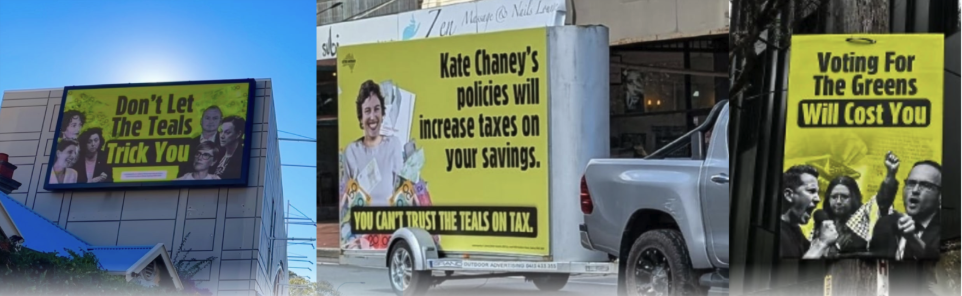
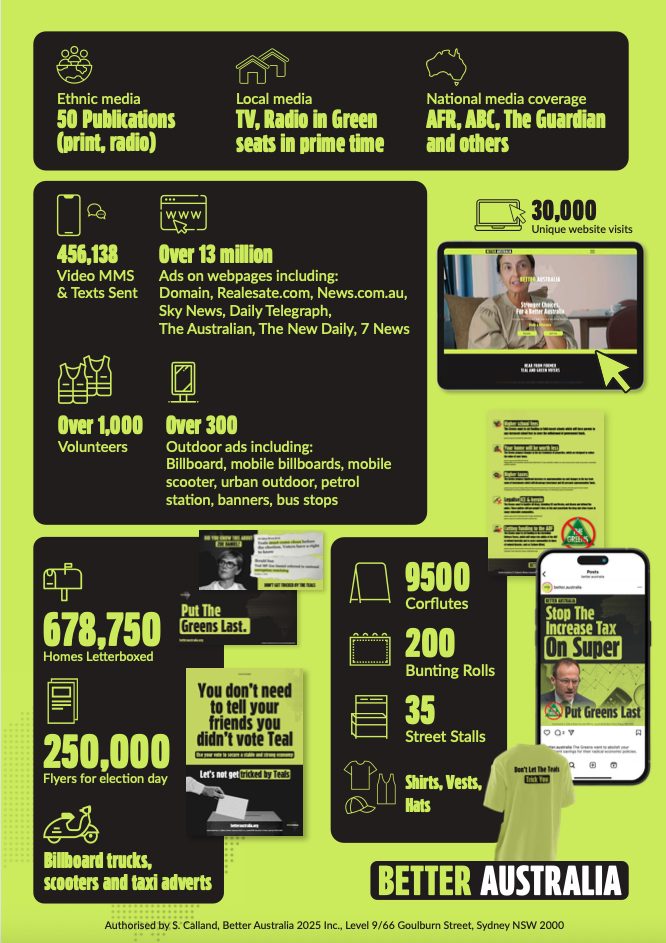
Agenda C created a range of printed materials for the campaign, which volunteers used nationwide for letterboxing, street stalls, and at polling booths.
We also designed materials for outdoor advertising, such as billboards, mobile billboards, scooters, street posters, banners, bus stop and electrical box posters.
Additionally, we produced items for general campaign activities, including corflutes, bunting, leaflets, shirts, vests, hats, and print advertisements including ethnic media based on census data in certain seats and negotiated significant editorial coverage.
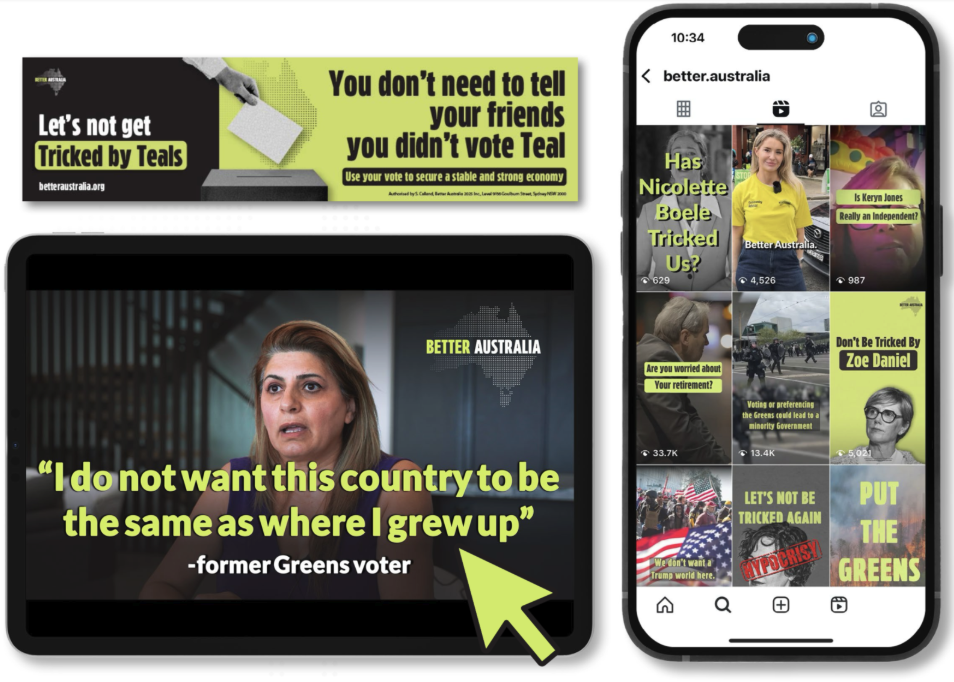
The
results
Agenda C developed different short-form videos for the campaign. These included video ads, short clips for text message campaigns, and testimonial videos.
We located ex-Green members, including a former Greens State Secretary and former Teal voters who have given testimonials which we have converted to powerful ads. Key multi-cultural influencers were also used for messaging within their follower networks.
- Ahead of the election