In the face of a campaign to devalue the contribution of non-government schools to Australia’s school system and reduce or remove the government funding they receive, Catholic Schools NSW asked Agenda C to create a communications campaign to defend school choice.
Keep School Funding Fair
Campaign video
The non-partisan campaign ran in the lead up to the 2022 federal election, ensuring that politicians from all parties were aware of the widespread community support and factored it into their election commitments.
The grassroots approach was also designed to support Catholic school enrolments and ensure the long-term viability of the Catholic school system into the future, while reinforcing the case for and building acceptance for the mixed model of school provision in Australia.
The campaign was designed to be able to ramp up should a greater threat to the school funding status quo emerge.
Qualitative research
In preparing for the campaign with desk and ethnographic research, Agenda C observed that some parents who send their children to Catholic schools hesitated to defend their choice to their family, peers or wider circle.
We set out to delve into the concerns that were holding them back, theorising that understanding these factors would allow us to convert quiet supporters into confident supporters. We also needed to discover what parents of children of all ages consider positives of Catholic schools and what they consider negative, map the decision-making journey and understand the influencers of parental choice.
We chose to undertake initial qualitative research as one-on-one in-depth interviews, recognising that the group dynamic of focus groups would drown out or skew the views of less confident parents.
As the in-depth interviews proceeded, we observed that many parents did not fully understand the school funding system, in which public schools are fully funded by government and non-government schools partially funded, with a scaled degree of parent contribution. Parents who were uncomfortable with non-government schools were often under the impression that they received more funding than government schools.
We tested this insight in a group setting using focus groups which brought together parents of children in government and non-government schools and identified that the dynamic between them was largely driven by the misapprehension around school funding, with parents in both school systems believing that more funding was going to the non-government sector, making school funding in Australia fundamentally unfair.
Quantitative research
To validate the hypothesis that it was this misunderstanding of the school funding system which was holding parents back from whole-heartedly defending school choice, we tested the insight in quantitative research. Here we found that, before the school funding system was clearly explained to them, 47 per cent of Australians believed they understood the school funding system and 40 per cent believed it to be unfair. However after reading a short explanation of the system, 56 per cent said they had not been aware of the system and 83 per cent agreed that the funding system should remain as it currently is.
The insight
It was clear to us that the key component missing to persuade Australians to support school choice was information about the education funding system status quo.
Once it was clearly explained to them, they would agree that it is important to keep school funding fair.

Source: Nine News Australia
Campaign creative
Agenda C developed a campaign to inform Australians about our means-tested school funding model.
Our creative was bright and positive, centred on children and families. Our tone was friendly and matter of fact. The campaign hub, keepfundingfair.org.au offered simple, clear information on the school funding system, including an animated video explainer, downloadable fact sheets and shareable social media tiles. Our Support hub allowed parents to sign up to support fair school funding and/or email their MP to express their views.
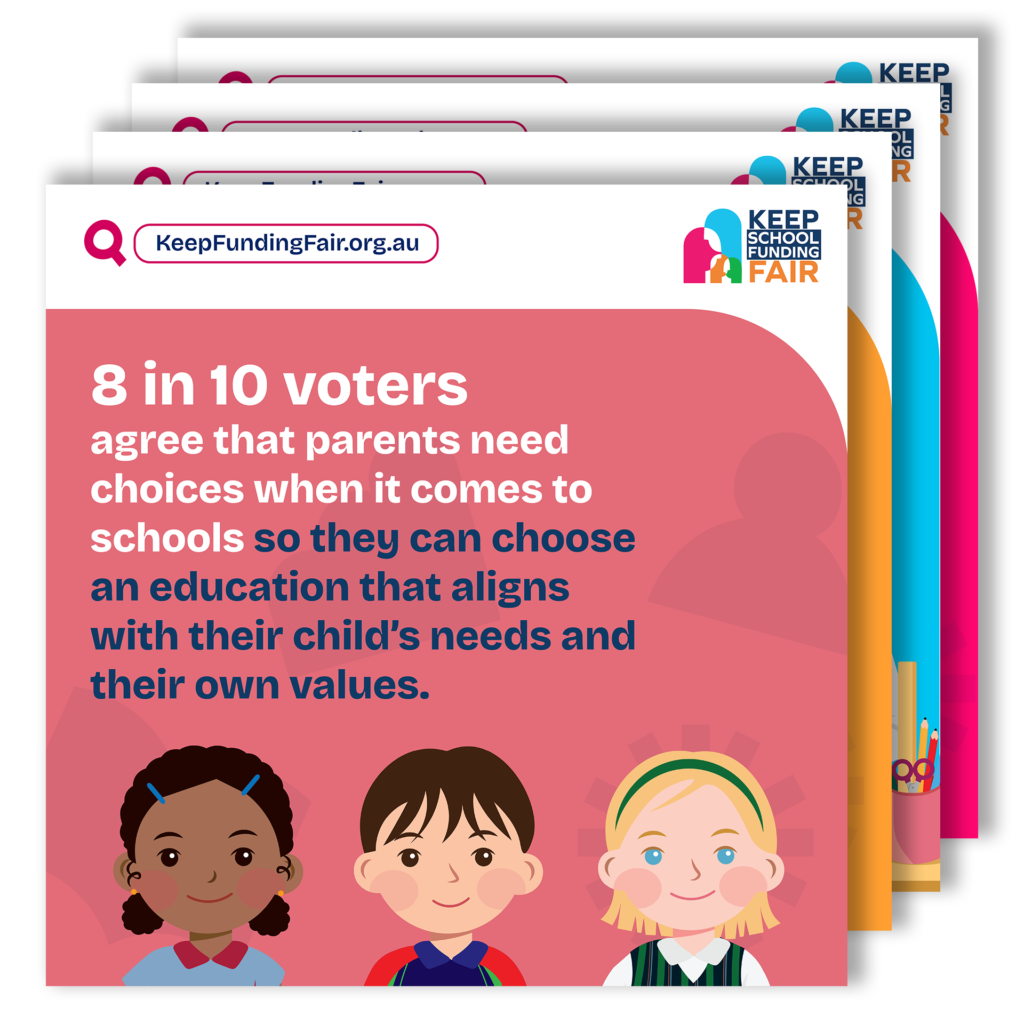
We developed bite-sized information tiles to run across social media, which created an always-on education piece targeted towards parents and policy makers.
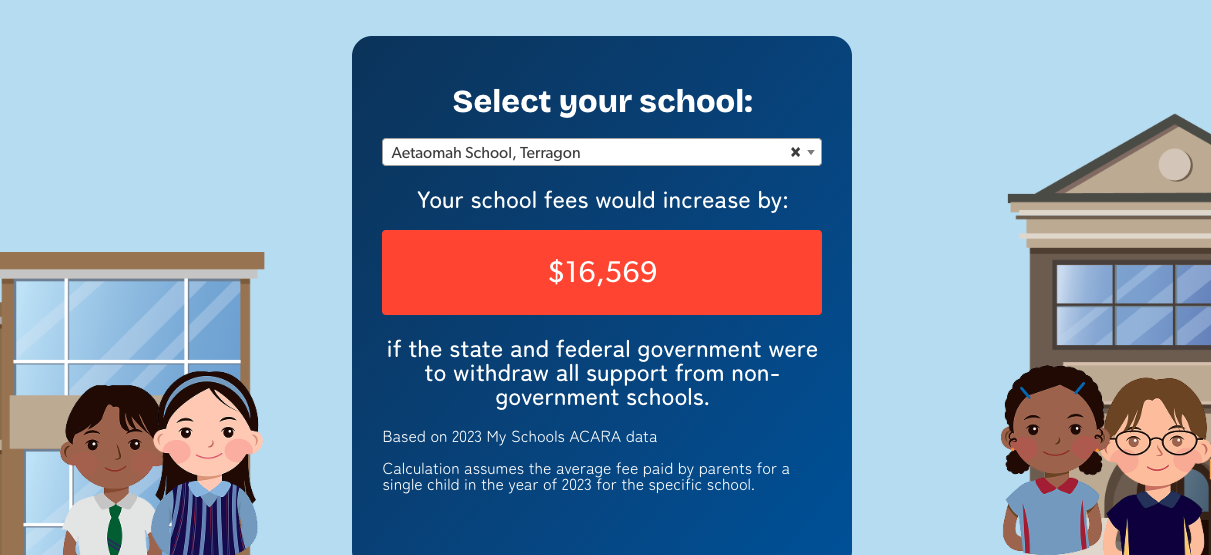
As the campaign progressed and Australians became more familiar with the funding model, we gave parents a more tangible stake in keeping school funding fair by putting a figure on how much more they’d pay in fees at their child’s school if the government provided no assistance, using a calculator tool.
Turning up the volume as the election approached
As the election got nearer and the voices calling for changes to school funding got louder, we activated our parent-advocates via a media campaign focusing on the sacrifices parents make to send their children to the school of their choice and reasons they choose to make those sacrifices. We brought these stories to life in the parents’ own words using social media videos, giving the campaign a relatable human face.
At the same time, we began running our campaign spot on Sky and placed our ads in airline lounges, to grab a larger share of policymaker attention.
The
results
- Ahead of the election
The prime minister declared that there would be no change to the school funding system.
- The Greens
Historically one of the loudest voices in favour of defunding Catholic schools, circulated a letter in which they declared there would be no change.
- school system
The number of Australians who understand the school funding system has increased and the work continues to ensure that it is understood by all.