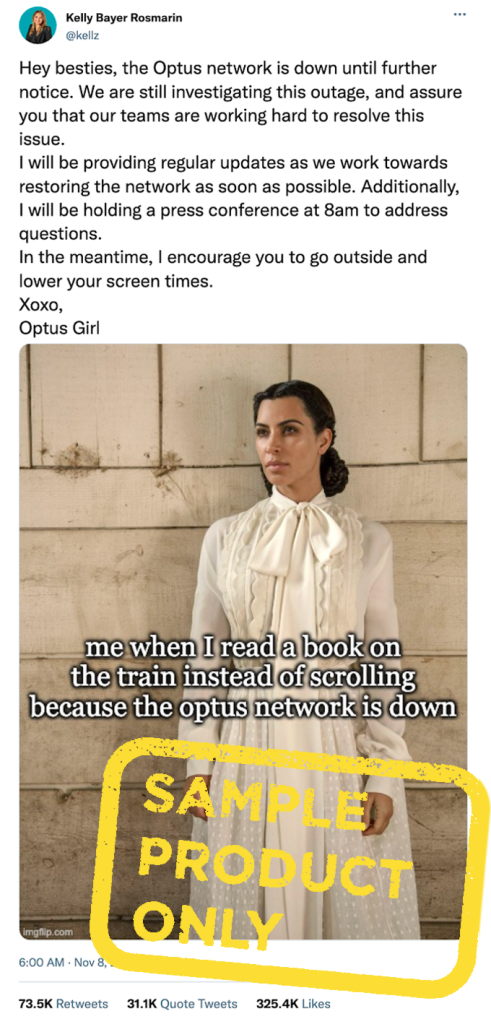
We finish this year with a deep sense of dread permeating corporate Australia. There is speculation in the boardrooms of companies of all sizes about what the departure of Kelly Bayer Rosmarin, the twice embattled CEO of Optus, means for everyone in governance and senior management. To many who can vividly imagine themselves in her high-heels, it looks like Bayer Rosmarin was forced into resigning over events that were not preventable and not her fault. The show-trial nature of the Senate enquiry which followed didn’t help. It ended, as show trials tend to, with a confession followed by a (thankfully metaphorical) execution.
But while the incidents themselves might not have been preventable, they need not have led to Bayer Rosmarin’s exit. In fact, her exit was the result of simple communications failures.
Strangely, the mistake that led to Bayer Rosmarin falling on her sword is a growing affliction. It has infected both politics and business.
Let’s call it the Scott Morrison effect.
Morrison failed to communicate well. At defining moments, he failed to communicate at all. It could be argued that most of the things which led to electoral unhappiness with Morrison were essentially communications based.
During the bushfires, he was on holidays. But it wasn’t the holiday that caused strife, but the fact it was kept quiet, until the media found out.
When the pandemic hit, Morrison was quick to lock down. But he left out the critical information Australians needed to feel some sense of control: there was no mention of a way out of lockdown and no roadmap to communicate what triggers or metrics would lead the government to consider easing restrictions. And then, when vaccination was critical, Morrison missed the opportunity to explain to Australians the considerations behind the vaccine acquisition strategy and the reason the rollout seemed to be delayed.
Not everything can be solved with good communication, but timely communication can give people affected by a situation a sense that they and their needs are a priority.
In the digital age, people are used to receiving information immediately - a quick search on Google, jumping on TikTok, a scroll through X, or a breaking news alert on the ever-present phone. We are now quicker to frustration than we ever were before when information isn’t available.
Leaders might rail at the information age (ironically the ex-Optus CEO among them) but those that reject it won’t lead much longer (the ex-Optus CEO being exhibit A). It wasn’t the crises itself that finished Bayer Rosmarin and co, but the failure to ensure the people who were affected were kept updated.
When the public experiences inconvenience, it helps us psychologically to know why. When something goes seriously wrong, we want to know what the plan is to fix it.
Bayer Rosmarin’s mistake was not something she did. It was doing nothing. For hours after the outage, the CEO of Optus was silent.
Given the number of channels available to communicate these days, every company that deals with a large number of customers should have a multi-media information strategy ready to go to keep the public up to date on any incident. Optus has social media accounts, the media was eager to run informative updates, with a little bit of creative flair, Optus could have reached customers through a range of third parties. Instead of journalists interviewing baffled commuters, the optics of this crisis could have been Optus living up to its promise to “go the extra mile” for its customers.
Much of what followed could have been prevented by providing information. And it didn’t even have to come from the CEO herself.