

Agenda C Synesis research exploring how voters are responding to Labor’s tax reform agenda.
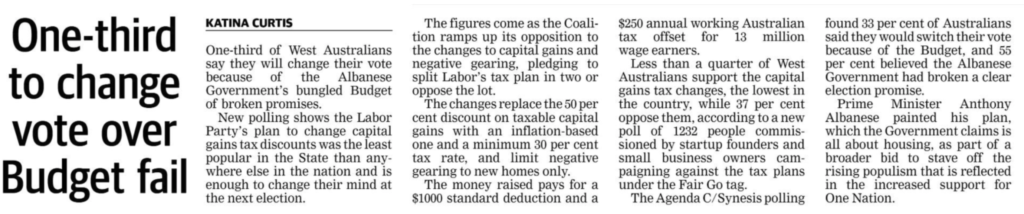
High voter awareness of the Budget’s tax changes is driving immediate political volatility, causing three in ten voters to reconsider their ballot and fuelling a distinct shift toward One Nation.
Public confidence in the Government’s economic narrative remains low, with widespread concerns that the policies will inadvertently discourage business investment, harm family enterprises, and worsen housing affordability.



RESEARCH TABLES
Agenda C | Synesis commissioned independent polling to understand what is shaping the NSW economy, community confidence, and voter expectations as the state moves toward 2026. We do this to replace assumptions with evidence, and to help decision-makers see the pressures and priorities that are driving behaviour in real time.
HIGH AWARENESS IS TURNING THE BUDGET INTO A LIVE POLITICAL RISK
79%
of voters had already heard at least something about the changes to capital gains tax, negative gearing and discretionary trusts before taking the poll. These measures are not sitting in the background.
LABOR LEADS — BUT ONE NATION IS NOW AHEAD OF THE COALITION
Voting intention today SUMMARY Weight: 2021 Census by Age, Gender and Location; sample size = 1232
THREE IN TEN VOTERS ARE RECONSIDERING THEIR VOTE
31%
of voters say they are now considering changing
their vote to a different party because of the
Budget’s tax changes. Another 17% say they are more
likely to stay with their 2025 party, while 38% are
unchanged
Among the 31% reconsidering their vote (n=377). The Budget backlash is flowing more strongly to One Nation than to the Coalition
VOTERS ARE MORE LIKELY TO OPPOSE THAN SUPPORT THE CGT CHANGES
36%
VS
27%
Opposition is more firmly held than support, with a quarter of voters sitting in the middle — a persuadable bloc.
NO MANDATE TO EXTEND CGT BEYOND HOUSING
The Government has applied the new CGT rules to all assets, including shares, business interests
and start-up equity. Voters were asked which approach they support.
Only 22% back applying the new rules to all assets as proposed. A clear majority would rather leave the 50% discount untouched or limit the changes to residential property. Among investment-exposed voters, 35% say don’t change the discount at all.
TRUSTS SPLIT VOTERS BETWEEN FAIRNESS AND SMALL-BUSINESS RISK
28%
say it risks hurting small
businesses, family businesses and
farmers who use trusts
legitimately
24%
say it is a fair way to stop highincome Australians using trusts to
reduce tax
26%
say both are true at the same
time
40%
Among voters personally exposed to a family or discretionary trust, the
small-business risk concern rises to 40% — while the fairness reading
holds steady at 24%.
THE GROWTH ARGUMENT IS NOT LANDING
Australian start-ups & private business
36%
say it risks hurting small
businesses, family businesses and
farmers who use trusts
legitimately
Climate technology & clean energy
37%
say both are true at the same
time
Opposition is more firmly held than support, with a quarter of voters sitting in the middle — a persuadable bloc.
ACROSS EVERY ASSET CLASS, VOTERS SAY THEY WILL INVEST LESS
ACROSS EVERY ASSET CLASS, VOTERS SAY THEY WILL INVEST LESS
HALF SAY THE GOVERNMENT BROKE AN ELECTION PROMISE
49%
of voters say the Government broke a clear
election promise by changing negative
gearing and the capital gains tax discount —
against just 27% who say the change has been
reasonably explained.
Election commitment and trust
Election commitment and trust SUMMARY Weight: 2021 Census by Age, Gender and Location; sample size = 1232
The Considered Response Methodology
The Considered Response is a national polling series by Agenda C Synesis. This wave was fielded one week after the May 12, 2026 Federal Budget.
- The survey was conducted via online panel.
- The sample size was n=1,232, a comprehensive exploration of Australian voters.
- The survey was conducted between 22-26 of May
- The survey data collection was national, and respondents were sourced using an accredited online research access panel.
- Data was weighted for representation against the 2021 ABS Census
- The margin of error is approximately +/- 2.8%
- Research conducted via online panels by Antenna Insights for AC Synesis.
Questionnaire design, strategic analysis, and reporting by Agenda C Synesis.
Survey programming, online panel, fieldwork, and data quality assurance by Antenna Insights.
What we publish
We share selected public insights to fuel informed debate, including voter sentiment on cost-of-living relief, housing affordability, energy priorities (balancing price, reliability, and emissions), productivity drivers, and emerging generational shifts. These findings highlight clear signals on what resonates and what risks eroding trust. Detailed electoral metrics, leader preferences, and party vote modelling remain reserved for confidential client briefings and commissioned work.